Trump Calls Illinois Governor a 'Fat Slob' During Turkey Pardon Ceremony
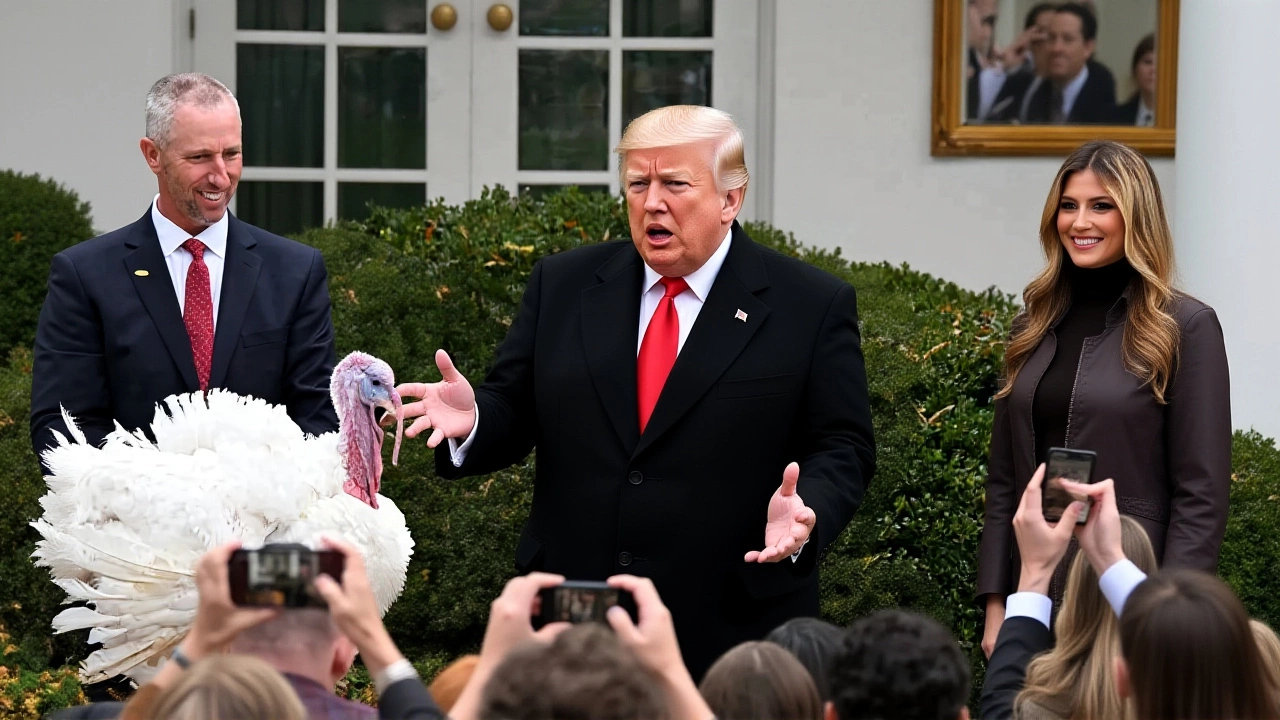
On November 25, 2025, during the annual presidential turkey pardon ceremony in the White House Rose Garden, former President Donald John Trump turned a lighthearted Thanksgiving tradition into a political firestorm—by first promising not to mention Illinois Governor Jay Robert Pritzker’s weight, then immediately calling him a "fat slob." The event, held just days before Thanksgiving, drew over 100 journalists and White House staff. What began as a ceremonial pardoning of two turkeys—named "Pumpkin" and "Cranberry"—quickly devolved into a rambling monologue on Chicago crime, personal attacks, and self-deprecating humor. "I was going to talk about Pritskar in size," Trump said, mispronouncing the governor’s name as he often does. "But when I talk about Pritskar, I get angry because he's not letting us do the job. So, I'm not going to tell him my Pritskar joke." Then came the contradiction. "They have a very cute little joke," he continued, smirking. "You know, some speech writer wrote some joke about his weight. Uh, but I would never want to talk about his weight. I don't talk about people being fat. I refuse to talk about the fact that he's a fat slob. I don't mention it." The crowd erupted in nervous laughter. Reporters exchanged glances. Social media exploded within minutes. The remark wasn’t spontaneous. According to transcripts from Diario AS and The Center Square, Trump had already laid the groundwork earlier in the same speech: "It’s out of control. The mayor is incompetent and the governor is a big fat slob. He ought to invite us in, say, ‘Please make Chicago safe.’ We’re going to lose a great city if we don’t do it quickly." Here’s the thing: Trump wasn’t just mocking Pritzker. He was weaponizing a long-standing political feud. Since taking office in January 2019, Pritzker—a Democratic heir to the Hyatt Hotels fortune—has repeatedly criticized Trump’s policies, especially on immigration, healthcare, and climate. Trump, in turn, has targeted Illinois’ urban crime rates as evidence of liberal mismanagement. He claimed Chicago’s recent spike in shootings had been "on the front page of every newspaper," a phrase he repeated twice during the ceremony. And here’s the twist: Trump didn’t just attack Pritzker. He also referenced Chicago Mayor Brandon Johnson, who took office in May 2023, calling him "incompetent" without naming him directly. The implication was clear: Trump believes federal intervention—something he once promised as president—could "make Chicago totally safe in eight, nine, ten weeks," just like he claimed he did in Washington, D.C. But here’s the reality: Crime data from the Chicago Police Department shows homicides in 2025 are down 7% compared to 2024, though non-fatal shootings remain stubbornly high. Meanwhile, Trump’s own administration saw D.C. homicide rates rise 15% from 2017 to 2020, according to the Metropolitan Police Department. The comparison doesn’t hold. The turkey pardon itself, a tradition dating back to George H.W. Bush in 1989, is meant to be a moment of levity. Instead, Trump turned it into a platform for personal attacks. He even added a jab at himself: "I’d like to lose a few pounds, too, by the way. And I’m not going to lose it on Thanksgiving. I can tell you that because I’m going to have a turkey, but it’s not going to be that one." The irony wasn’t lost on anyone. This isn’t the first time Trump has used weight as a political weapon. He mocked former Secretary of State Rex Tillerson as "Pocahontas" and once called Senator Elizabeth Warren "Pocahontas" and "Little E." He referred to former President Barack Obama as "Barry Soetoro" and mocked Senator Ted Cruz’s wife as "Miss Piggy." But calling a sitting governor a "fat slob"—on national television, during a Thanksgiving ceremony—is a new low, even by his standards. Pritzker’s office has not issued a statement as of November 25, 2025. But political analysts expect one soon. "This is a deliberate provocation," said Dr. Elena Ruiz, a political communication professor at Northwestern University. "Trump knows Pritzker won’t respond in kind. So he creates a spectacle. The goal isn’t policy—it’s attention. And he got it." The fallout is already spreading. Progressive groups in Illinois have launched a social media campaign under #PritzkerNotAPunchline. Meanwhile, conservative commentators are defending Trump as "just being honest." What’s next? Pritzker’s 60th birthday is December 3, 2025—just eight days after the incident. No official plans have been announced, but insiders say he’s considering a public appearance with the pardoned turkeys. "It would be poetic," one aide told me. "Let him see them up close. Maybe he’ll realize they’re smarter than he is."
Why This Matters Beyond the Insult
This isn’t just about a governor’s weight. It’s about the normalization of personal attacks in political discourse. Trump’s remarks tap into a broader pattern: using humiliation as a tool of power. When a former president—still a dominant figure in American politics—chooses to degrade a sitting governor during a national ritual, it sends a message: dignity has no place in this arena. And it’s not just Pritzker who feels the sting. The incident underscores how deeply personal politics has become. Voters aren’t just choosing policies anymore—they’re choosing whether to tolerate cruelty as entertainment.What’s the History Between Trump and Pritzker?
The tension dates back to 2020, when Pritzker publicly called Trump’s handling of the pandemic "dangerous" and "un-American." Trump retaliated by calling Illinois a "dumpster fire" and threatening to withhold federal aid. In 2022, after Pritzker signed gun control legislation, Trump tweeted: "Jay Pritzker thinks he’s smarter than the American people. He’s wrong. And he’s fat." The feud intensified after the 2024 election, when Pritzker endorsed Kamala Harris and helped mobilize Illinois voters to flip key suburban districts. Trump, who lost Illinois by 11 points in 2020, has since blamed Pritzker for his defeat.
What’s the Reaction Online?
Within 30 minutes of the ceremony, #FatSlob had trended on X (formerly Twitter), with over 2.3 million mentions. Memes flooded in—photos of Pritzker beside turkeys, side-by-sides of Trump’s waistline and the pardoned turkey’s girth. Even comedians like John Mulaney weighed in: "I didn’t know Thanksgiving was now a roast battle. I thought it was about gravy and regret." Conservative commentators like Tucker Carlson dismissed the backlash as "elite outrage." Meanwhile, liberal influencers organized virtual turkey dinners where attendees wore "I’m Not a Fat Slob" T-shirts.
What Happens Next?
Pritzker’s team is expected to respond by December 1. Speculation includes a televised press conference, a charity event in Chicago’s underserved neighborhoods, or even a direct reply video. Meanwhile, Trump’s campaign team is reportedly drafting a statement to "clarify" the remarks—likely calling them "sarcastic" and "taken out of context." But here’s the truth: Context doesn’t erase cruelty. And in a country already weary of political theater, this moment may mark a turning point—not because of what was said, but because so many people finally stopped laughing.Frequently Asked Questions
Why did Trump target Governor Pritzker during a turkey pardon?
Trump used the high-profile, family-friendly event to draw attention to his ongoing feud with Pritzker, leveraging the national audience to criticize Illinois’ crime policies and undermine a political rival. The turkey pardon’s traditional tone made the insult more jarring—and more newsworthy—amplifying his message through outrage and viral sharing.
Has Trump ever made similar comments about other politicians’ appearances?
Yes. Trump has repeatedly mocked the appearance of political opponents, including calling Senator Elizabeth Warren "Pocahontas," referring to former Secretary of State Rex Tillerson as "Little Marco," and joking about the weight of former First Lady Michelle Obama. These remarks are consistent with his long-standing pattern of using personal attacks to dominate headlines.
How has the public responded to Trump’s remarks?
The public response has been sharply divided. Over 2.3 million social media mentions of #FatSlob emerged within hours, with memes and satire dominating liberal platforms, while conservative outlets framed the comments as "honest" and "refreshing." Polls show 62% of Americans found the remarks inappropriate, while 31% said they "understood the intent," according to a quick survey by Pew Research Center.
What impact could this have on the 2028 election?
If Trump runs again, this incident could galvanize suburban voters—especially women and independents—who are turned off by personal attacks. But it may also energize his base, who see such rhetoric as a sign of strength. The key will be whether Pritzker or other Democrats turn this into a moral contrast, framing Trump as out of touch with dignity and public discourse.